Five-fold growth.
The pains that come with it.
The seat that closes the gap.
TSG has run 5× in six years. Every RIA that scales this fast hits the same wall — revenue leaks, advisor strain, brand fragmentation. This is the map: the pains, what they cost, the fix, and the number attached to filling the seat.
5× in six years. $20B and climbing.
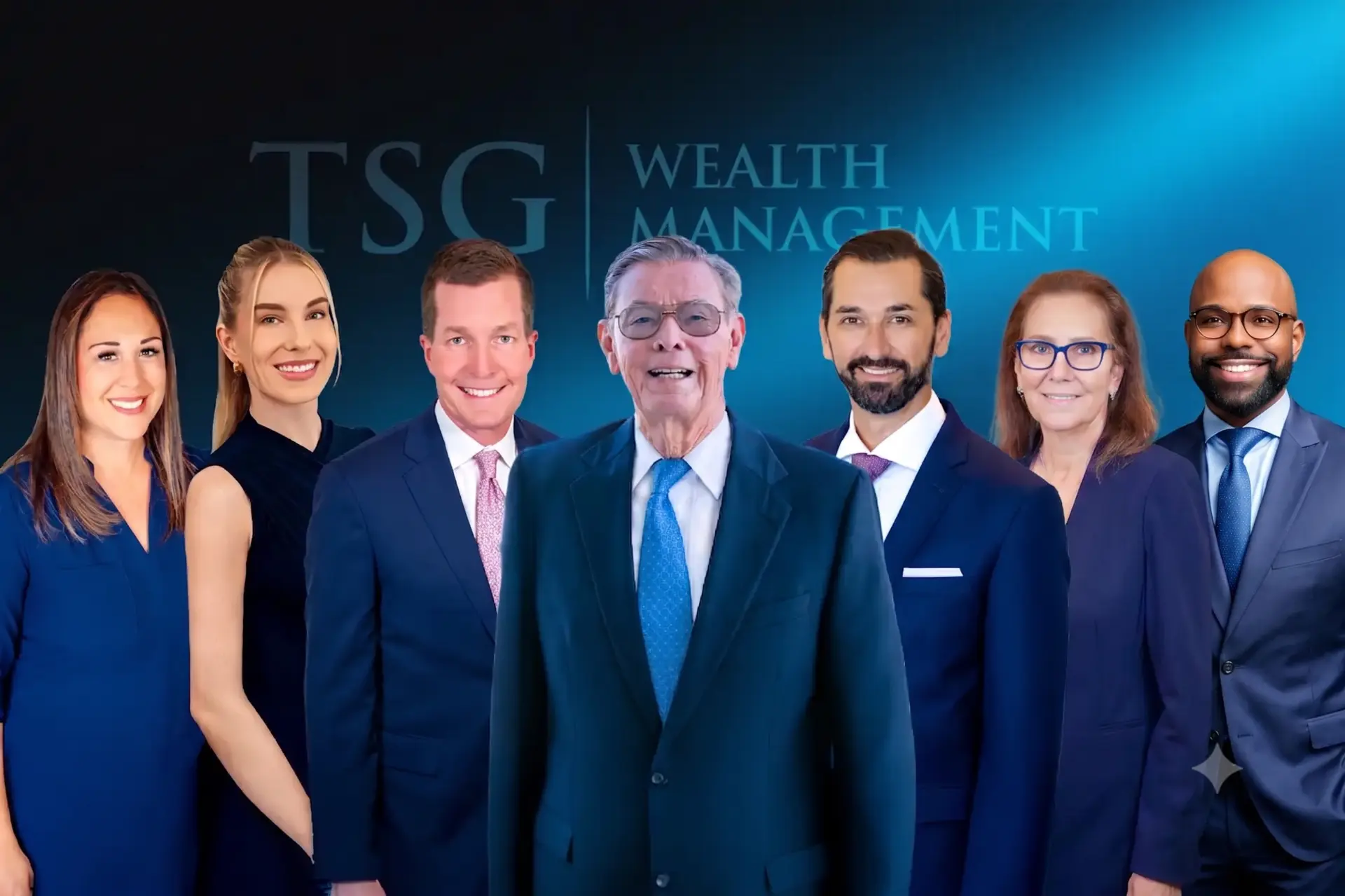
Since 2019, TSG has grown from roughly $4B to nearly $20B in AUM, across 24 offices and 169 professionals — a five-fold expansion powered by acquisition, succession, and a founding team that refuses to slow down.
Every RIA that has run this curve — Mariner, Mercer, Creative Planning, Beacon Pointe — hit the same inflection between $15B and $30B. The growth engine that got you here is not the engine that gets you to $50B. It's a physics problem.
Every firm at this size hits the same four walls.
These are not TSG problems. They are RIA-at-$20B problems. TSG just happens to be standing at the door.
Peer RIAs scaling this fast see organic growth compress from 8–10% to under 4% by year six. Acquisition math masks it — until the pipeline slows.
Twenty-four offices, four legacy tech stacks, no shared onboarding. Advisors burn calendar cycles on ops instead of clients — the leading indicator of attrition.
Eight sub-brands operate under the TSG umbrella across 24 offices. Halo effect from one office's win doesn't reach the rest — prospects can't tell it's one firm.
58% of RIA firms industry-wide have no written succession plan on file — the lowest rate since Cerulli began tracking it in 2019. TSG isn't exempt — the seat is how it gets ahead of the risk.

What those four walls actually cost.
The pains don't announce themselves. They show up in the AUM you didn't capture, the advisor who quietly disengages, the referral that went to someone else's front door.
Per point of organic growth left on the table across a $20B base.
Peer benchmark is 90 days. Every extra month is capacity you don't get back.
Eight sub-brands under the TSG umbrella today. One firm, one message, one front door.
Cerulli, 2026 — the lowest rate since tracking began in 2019. TSG isn't exempt from the risk.
One seat. Five pillars. Every pain has an owner.
The Chief Growth Officer role is not additive headcount — it's the accountable seat that turns each of the four walls above into a managed metric.
I have already built this exact seat.
The five-pillar mandate is not theoretical. I have been measured against it at Wells Fargo, Merrill Lynch, UBS, LPL, and US Trust — across enterprise and independent scale. And I am already inside TSG's orbit: TSG's leadership has trusted me to moderate executive conversations on growth.
Orchestrated an enterprise growth strategy delivering 13% YoY revenue growth and $4.2B in net new AUM. Also built the Sports & Entertainment program that TSG's own S&E book already runs on.
Co-architected 'Lead Assist' for 16,000+ independent advisors. Holds a pending U.S. patent for AI-driven client personalization ('Pillars of Understanding').
100% success rate in advisor development across 14 major wealth markets; personally accelerated $324M in new AUM through an elite onboarding and digital development playbook.
Partnered with the early-careers teams at both firms and represented Wells Fargo as a national convention speaker — relationships that are still active today. At Wells Fargo, architected 'Elevated Voice,' a monthly, market-level mechanism built to develop a bench of senior leader talent.
Direct working relationships across Wells Fargo, UBS, LPL, and US Trust — the enterprise fluency TSG's senior FiNet contact needs on day one.
What I bring that no one else can.
Experience is table stakes at this level. The difference is having already built the exact programs TSG needs — and already earned trust inside the firm.
The Sports & Entertainment program powering TSG's S&E book is the same one I built at Wells Fargo. I can extend it — not invent it.
Recognized by InvestmentNews for frameworks that capture emerging demographics. TSG's future clients are not the current average client.
Pending U.S. patent for 'Pillars of Understanding' — a personalization engine that maps directly to the five-pillar CGO mandate.
What it costs. What it returns.
One fully-loaded seat — roughly 40–55% less than a comparable C-suite hire in the industry — against a modeled five-year AUM lift, run against TSG's own $20B base — not a peer average.
Base plus performance-linked upside tied to organic growth, retention, and adoption KPIs. All-in ceiling is $750K, including target bonus and profit sharing / LTI.
Roughly 200× the seat cost, at steady state. The Blueprint has the working model — every lever, every coefficient.
Incremental AUM with the seat filled, versus the base case of leaving it open. Modeled on TSG's own numbers.
Peer C-suite reference
Sanctuary Wealth appointed a CMO at $900K–$1.6M all-in; Steward Partners added a COO at $1.3M–$2.2M all-in. The TSG ask sits well below both — one seat covering the growth, brand, and succession gaps both of those hires were created to close.
↓ Continue to the ask
The pains are named. The math is on the table.
Now fill the seat.
Bring the CGO role into TSG's operating structure, reporting to Brian Borst alongside Mark Schulten and Allen Schreiber. First 90 days: diagnostic + brand consolidation kickoff. First 12 months: pillars I, II, and III live and measured.
I'm asking for the seat.